Testing,Architecture,CI/CD
Parallel Vitest + Karma Testing Strategy
Introduced a parallel testing strategy to modernize enterprise Angular test coverage safely, enabling continued feature development while incrementally migrating from Karma to Vitest.
142+Vitest Tests Added
14Spec Files Created
14Components Covered
2Apps Converted to Parallel Testing Karma + Vitest
The Problem
Legacy Karma-based testing made framework upgrades increasingly risky and slowed development velocity.
At the same time, modern tooling such as Vitest offered faster execution and improved maintainability aligned with evolving frontend ecosystems.
Quick Summary
TL;DR
- Problem: Legacy Karma-only testing made Angular upgrades slower, riskier, and harder to scale
- Solution: Introduced a parallel Vitest + Karma strategy so modern tests could be added without disrupting existing coverage
- Impact: Reduced upgrade risk, improved developer experience, and created a safe path toward long-term test modernization
Technical Leadership
- Identified early risks with adopting a Jest-based testing approach during Angular upgrade efforts observed in similar environments, where compatibility challenges introduced instability and increased migration complexity.
- Proactively evaluated alternative solutions and advocated for adopting Vitest as a more compatible, forward-looking option.
- Organized and led discussions with engineering leadership to align on a safer long-term testing strategy
- Secured buy-in from the Lead Engineer and Engineering Manager
- Defined the architectural direction for test modernization
What I Did
Parallel testing architecture enabling safe, incremental migration from Karma to Vitest.
Implemented a parallel testing strategy by introducing Vitest alongside existing Karma tests rather than replacing them outright.
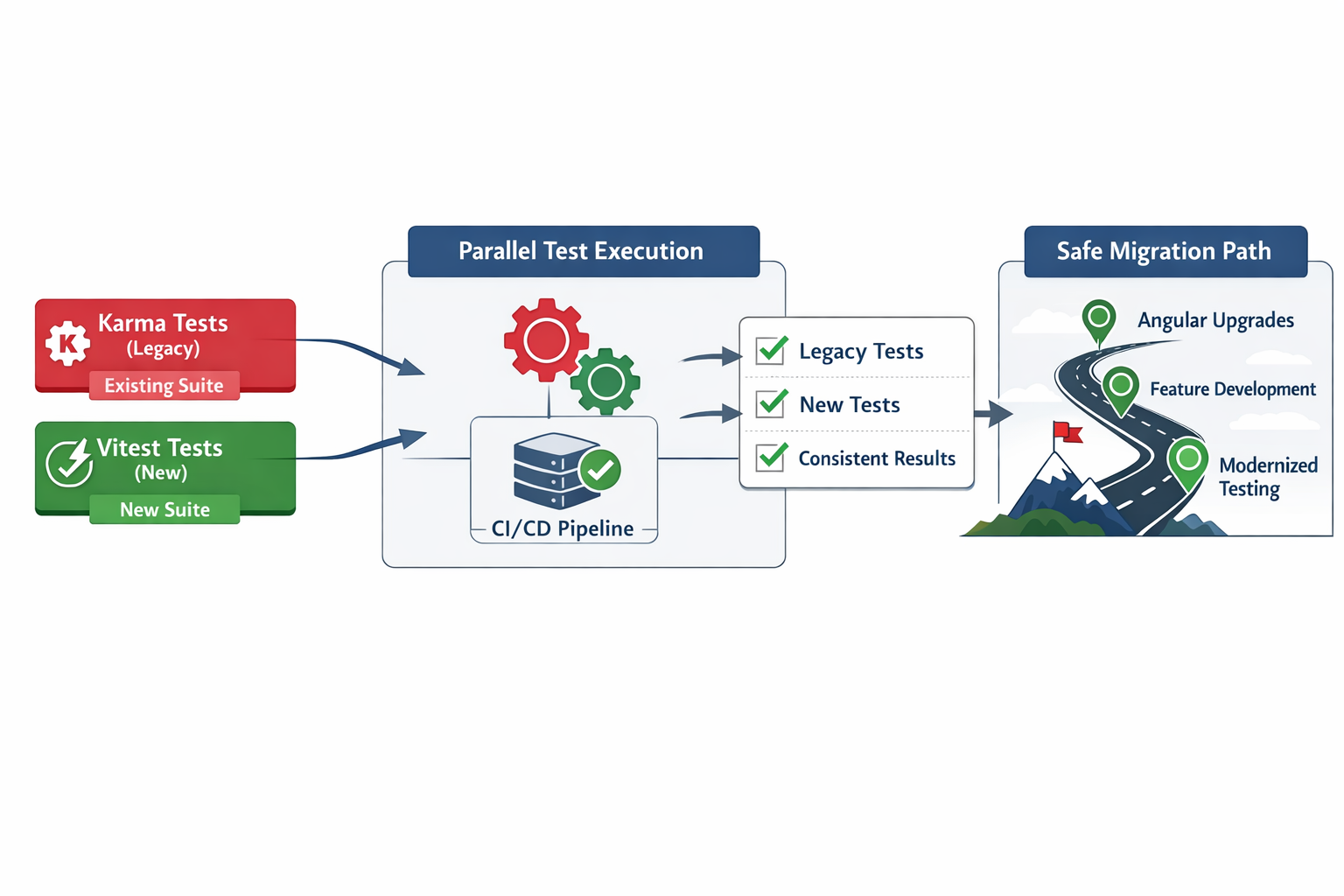
- Incremental Migration Strategy: Enabled new tests to be written in Vitest while maintaining existing Karma coverage, avoiding a risky “all-at-once” rewrite.
- Test Runner Isolation: Defined clear naming and structural conventions to ensure both test runners could coexist without execution conflicts.
- Optimized Test Patterns: Established patterns for faster, more focused unit tests using shallow rendering, mocking, and component isolation—shifting away from heavier integration-style tests where appropriate.
- Developer Experience Improvements: Simplified workflows by introducing dedicated commands for each test runner and ensuring consistent local execution.
- CI/CD Integration: Configured the pipeline to execute both test suites in sequence, maintaining confidence in legacy coverage while validating new Vitest-based tests.
Testing and Validation
Validated the approach through continuous integration and real-world usage.
- Ensured both test suites executed reliably within CI pipelines
- Verified consistency in pass/fail behavior across critical application flows
- Introduced new Vitest tests across multiple components, including shared UI and authentication-related functionality
- Confirmed that new tests improved coverage without introducing regressions
Outcome
- Enabled safer Angular upgrades without requiring a full testing rewrite
- Maintained development velocity, avoiding a feature freeze during migration
- Improved developer experience with faster, more focused test execution
- Reduced long-term maintenance overhead by establishing a modern testing foundation
- Provided a scalable migration path for gradually transitioning away from legacy tooling