SaaS,Architecture,Angular,Full Stack
Planning and Building a Specialized Multi-Tenant SaaS CMS
Planning and developing a multi-tenant SaaS content platform that will give small and medium-sized businesses in a specialized market a responsive, customizable web application without exposing the product's protected vertical concept.
The Problem
Many small and medium-sized organizations rely on generic site builders, disconnected third-party tools, or aging websites that do not reflect the workflows of their market. Those options can create a choice between low-cost software that lacks specialized capabilities and custom development that is expensive to maintain.
The opportunity is to provide a focused platform that combines responsive public experiences, structured content management, configurable branding, and market-specific workflows in one product.
Because the differentiating business concept is still being developed, the public case study must demonstrate the technical and product strategy without identifying the target vertical or disclosing the specialized features that create its competitive advantage.
TL;DR
- Problem: A specialized SMB market needs responsive, configurable web applications without the cost and fragmentation of one-off development
- Solution: Design a multi-tenant SaaS CMS with tenant isolation, role-based administration, reusable components, and configuration-driven presentation
- Impact: Creates a scalable path from one focused implementation to a repeatable product while protecting the underlying market concept
Technical Leadership
- Defined the product boundary between reusable platform capabilities and tenant-owned content and appearance configuration.
- Planned a role model covering platform administration, tenant ownership, delegated content management, and public users.
- Designed customization as structured configuration rather than customer-specific source-code branches.
- Separated the responsive public experience from administrative workflows while keeping both aligned to a shared content model.
- Created a phased roadmap that allows the frontend experience and domain model to mature before multi-tenant infrastructure is finalized.
- Balanced portfolio transparency with product confidentiality by documenting architectural decisions without exposing the target market.
Business Context
This is an independently conceived product initiative for a specialized small-to-medium-business market. Public documentation intentionally discusses the reusable platform architecture while withholding the target industry, identifying workflows, prospective customers, and go-to-market details.
Constraints
- Protect the target vertical and differentiating business workflows while the product is under development.
- Keep each tenant's content, users, configuration, and media logically isolated.
- Support meaningful customization without forking the application for every customer.
- Provide approachable administration for business owners and authorized staff.
- Build incrementally so early implementations can validate the product before broader SaaS expansion.
What I Did
A configuration-driven platform can provide distinct customer experiences while preserving one maintainable product.
The application is being developed as a reusable component system backed by tenant-owned content and appearance configuration. Layouts, typography, colors, media, navigation, and specialized content can vary by tenant without requiring separate application code.
The planned server architecture adds tenant-aware authorization and data access to every administrative operation. Content records will support complete create, read, update, and soft-delete workflows while preserving recovery options and an auditable lifecycle.
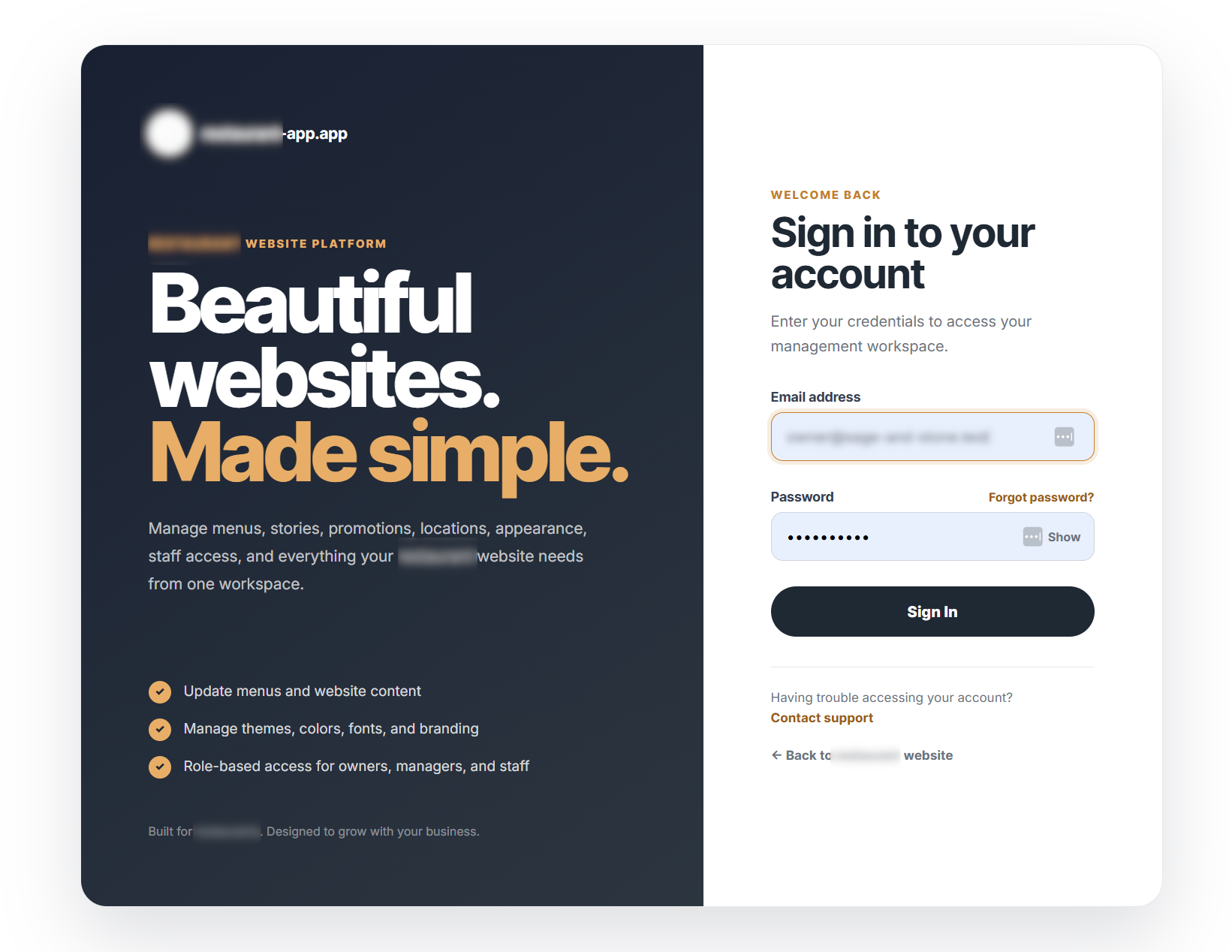
- Established a modern Angular application and reusable design system for responsive public-facing experiences.
- Created configuration models for colors, typography, layout, navigation, media, and component-level presentation.
- Designed platform presets that can be extended into tenant-specific configurations without changing shared components.
- Planned tenant-aware APIs and persistence using Node.js, Fastify, Prisma, and PostgreSQL.
- Defined role-based administrative boundaries for platform operators, tenant owners, delegated staff, and public users.
- Outlined create, read, update, and soft-delete workflows for managed content and administrative accounts.
- Separated development and preview tooling from the simplified experience intended for business users.
- Structured the roadmap around a focused initial implementation followed by tenant provisioning, subscription capabilities, and broader rollout.
Testing and Validation
The product is being validated incrementally. Current work tests whether a single shared component system can support visibly distinct customer experiences while keeping content structures and administrative concepts consistent.
Later phases will validate authorization boundaries, tenant isolation, content recovery, deployment automation, and the onboarding experience before wider availability.
- Compare multiple appearance configurations against the same responsive component system.
- Verify public routes and development previews remain correctly separated.
- Test components with varied content lengths, media proportions, and viewport sizes.
- Plan automated authorization tests to prevent cross-tenant access.
- Plan integration coverage for content lifecycle, account administration, and soft-delete recovery.
- Use early implementations to refine the content model before scaling tenant provisioning.
Outcome
- Established the architectural direction for a specialized SaaS product without disclosing its protected vertical.
- Built the foundation for distinct branded experiences on top of one maintainable application.
- Defined the roles, content lifecycle, and tenant boundaries required for secure administration.
- Reduced future duplication by making customization configuration-driven from the beginning.
- Created a phased path from working prototype to multi-tenant commercial platform.