Angular,Frontend Architecture,State Management,Gaming
Rummy.green Angular Game Engine Validation
Built a production Angular 21 frontend and reducer-driven game engine for a multiplayer Rummy platform before backend persistence existed, using AI opponents as a validation mechanism to continuously test and refine gameplay logic.
The Problem
The project began as a frontend-focused effort without a backend, database, or persistent game state. While card rendering and user interaction could be implemented quickly, validating gameplay rules presented a much larger challenge.
Rummy contains numerous gameplay rules involving turn order, drawing, discarding, meld creation, runs, scoring, and win conditions. Testing these scenarios manually became increasingly inefficient as complexity grew.
Without additional players or a multiplayer backend, many gameplay paths could not be exercised consistently, making it difficult to identify edge cases and validate that the game engine was behaving correctly.
TL;DR
- Problem: Complex game rules needed validation before backend infrastructure existed
- Solution: Built a reducer-driven Angular game engine and introduced AI players to continuously exercise gameplay scenarios
- Impact: Accelerated game engine development, uncovered edge cases early, and established a foundation for future multiplayer expansion
Technical Leadership
- Designed the initial game architecture around a reducer-driven state management approach to keep gameplay logic predictable and testable.
- Recognized early that manual testing would not scale as game complexity increased.
- Introduced AI-controlled opponents as a development and validation tool rather than waiting for multiplayer functionality.
- Created reusable game actions that could be executed by both human players and AI players.
- Established a foundation that later enabled multiplayer support without rewriting core gameplay logic.
What I Did
AI opponents became an automated validation system for game engine development.
Rather than waiting until multiplayer infrastructure existed, the application introduced AI players capable of executing the same game actions available to human players. This allowed the game engine to be continuously exercised under realistic gameplay conditions while development was still entirely frontend-driven.
Because both human and AI players used the same reducer-driven game engine, every AI turn provided additional validation of game rules, state transitions, and edge-case handling.
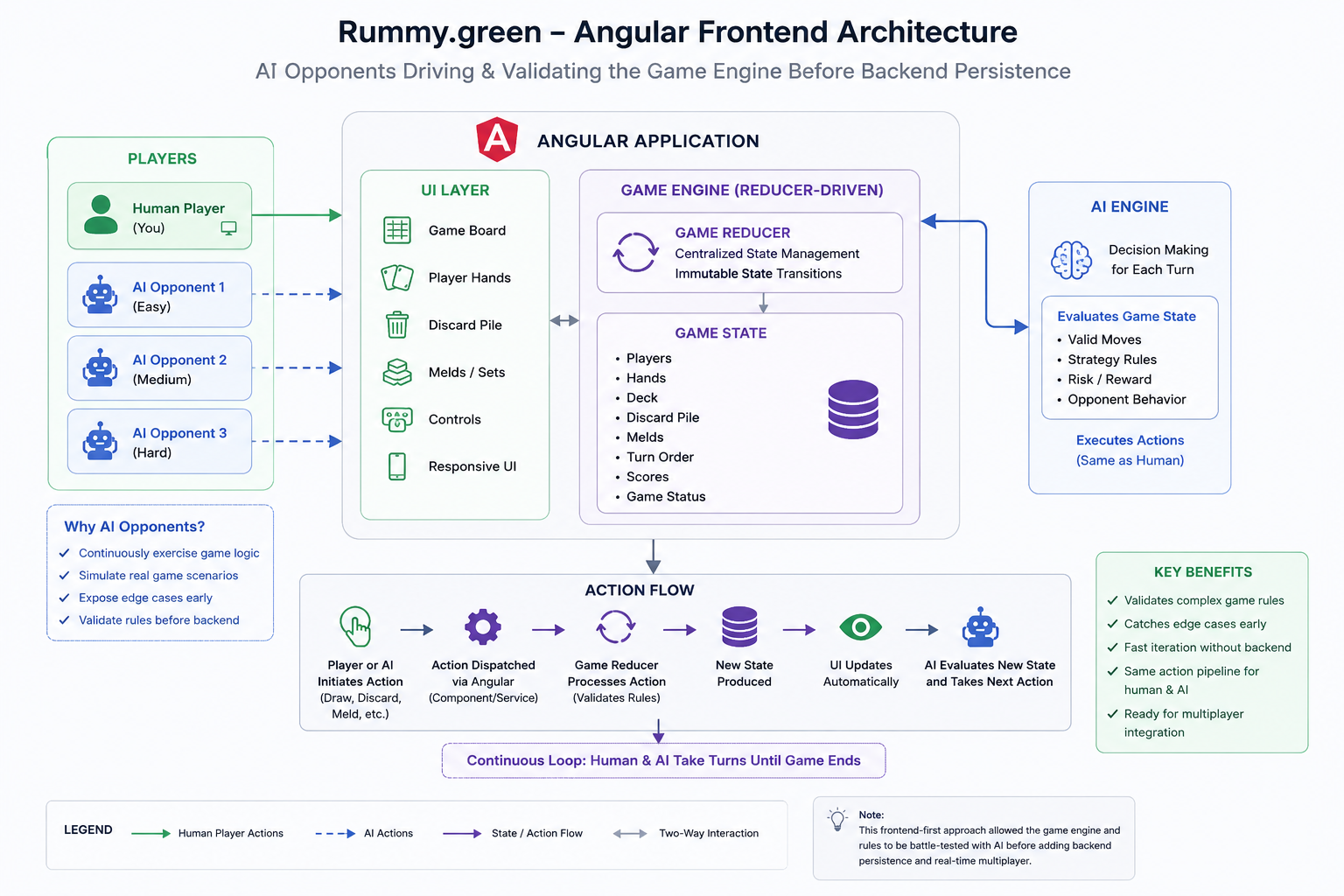
- Implemented a reducer-driven game engine to centralize gameplay logic and state transitions.
- Created AI opponents capable of evaluating game state and executing valid game actions.
- Ensured AI players used the same action pipeline as human players, providing realistic validation of gameplay rules.
- Designed game actions such as drawing, discarding, creating melds, and ending turns to be reusable across human and AI interactions.
- Used AI gameplay to identify edge cases involving turn order, hand management, discard behavior, and win-condition evaluation.
- Established a frontend architecture capable of supporting future multiplayer integration without major refactoring.
Testing and Validation
Validation occurred continuously through actual gameplay rather than isolated unit testing alone.
Each AI turn exercised the same game engine used by human players, providing a constant stream of gameplay scenarios and helping expose logic defects early in development.
- Verified turn sequencing across multiple player counts.
- Validated draw, discard, meld, and scoring logic during active gameplay.
- Confirmed AI and human players shared identical game actions and state transitions.
- Tested 2-player, 3-player, and 4-player game configurations.
- Used repeated AI gameplay sessions to uncover and resolve edge cases.
Outcome
- Created a fully playable frontend experience before backend development began.
- Validated core gameplay mechanics through thousands of AI-driven game actions.
- Identified and resolved gameplay edge cases significantly earlier in development.
- Reduced risk when later introducing multiplayer infrastructure and persistent state.
- Established a scalable game engine architecture that now supports both AI opponents and multiplayer gameplay.